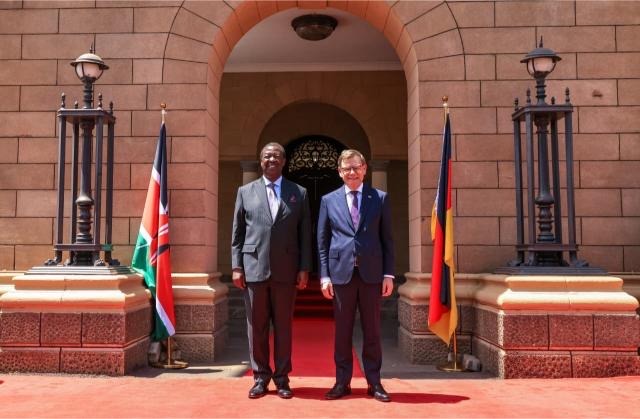
Kenya and Germany have reaffirmed their longstanding bilateral partnership, with both countries committing to deepen cooperation in development, climate action, migration, and regional security during the official visit of German Foreign Affairs Minister, Johann Wadephul.
Speaking during bilateral talks in Nairobi on Monday, Prime Cabinet Secretary and Cabinet Secretary for Foreign and Diaspora Affairs Musalia Mudavadi said the visit underscored the strong and enduring ties between the two nations, dating back to Kenya’s independence in 1963.
“Kenya greatly appreciates the fact that Germany was among the first countries to recognise our country’s independence, and we highly value the longstanding diplomatic relations between our two countries,” Mudavadi said.
Mudavadi noted that Germany remains one of Kenya’s most significant development partners, ranking fifth overall, with commitments totalling approximately €2.5 billion. (Sh375 billion)
He highlighted German support in climate action, renewable energy, and sustainable agriculture, including €153 million (Sh23.1 billion) committed between 2022 and 2024, as well as a €400 million (Sh60.4 million) clean energy portfolio supported through German development agencies KfW and GIZ.
The Prime Cabinet Secretary said economic ties between the two countries continue to grow, with more than 120 German companies currently operating in Kenya.
He also pointed to the Comprehensive Migration and Mobility Partnership signed in 2024 as a key framework for strengthening skills development and promoting structured labour mobility between the two countries.
Mudavadi highlighted Germany’s support for youth employment and vocational training, noting that the dual Technical and Vocational Education and Training (TVET) system, implemented in partnership with Kenya’s Ministry of Education, has already benefited more than 10,000 young Kenyans.
“This visit is a clear demonstration of the cordial and mutually beneficial relations between our two countries, founded on shared values of democracy, multilateralism, and respect for international law,” he said.
The two sides held extensive discussions on priority areas including migration and mobility, climate change, renewable energy, peace and security, and multilateral cooperation.
Mudavadi said Kenya briefed Germany on reforms undertaken to strengthen ethical recruitment practices, protect migrant workers, and improve labour migration governance, with both countries agreeing to accelerate implementation of the migration partnership through skills alignment and language training.
On climate cooperation, Mudavadi said the discussions focused on geothermal energy, green hydrogen, and Kenya’s clean energy transition, noting alignment between Germany’s climate diplomacy and Kenya’s goal of achieving 100 percent clean energy by 2030.
Regional peace and security also featured prominently in the talks, with the two countries exchanging views on conflicts in Sudan, South Sudan, Somalia, and the Democratic Republic of Congo, and reaffirming support for African-led peace initiatives and coordinated international engagement.
At the multilateral level, both Kenya and Germany reiterated their commitment to a rules-based international order and the need for reforms to make global institutions more inclusive and effective.
Kenya expressed optimism that the visit would further strengthen cooperation with Germany for mutual benefit and in support of regional and global stability.